





















 INJECTORS




 TURBOS
 FUEL PUMPS
 ACTUATORS
 EGR Coolers
 Contamination Kits
 Accessories Kits
Turbo Oil Starvation Causes and Proven Repairs

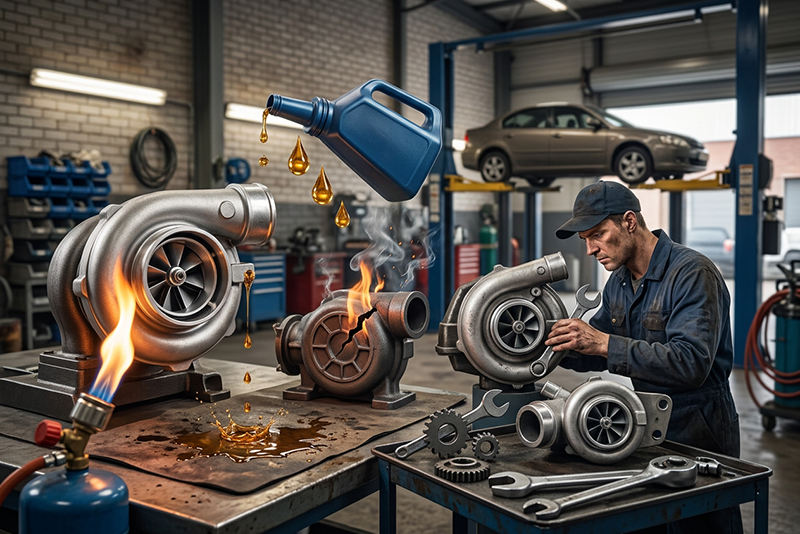
A turbocharger can be damaged in seconds when its oil supply fails. Turbo oil starvation is one of the fastest ways to turn a repairable truck into an expensive downtime event, whether you run a Cummins, Power Stroke, Duramax, Detroit, CAT, Paccar, or International diesel. The turbo relies on a constant flow of clean, correctly pressurized oil to support and cool its center housing rotating assembly. Restrict that flow, and the shaft, bearings, and wheels can fail before the driver has time to react.
A replacement turbo may restore boost, but it will not correct the reason the original unit failed. Install a new or remanufactured turbo without finding the oiling problem, and the replacement can suffer the same damage. That is why a proper diagnosis must start with the engine’s oil supply and drain system, not the turbocharger alone.
What Turbo Oil Starvation Does to a Diesel Turbo
Inside the turbo center section, engine oil forms a protective film around the rotating shaft and bearings. At operating speed, the turbocharger can spin well over 100,000 RPM. There is no margin for dirty oil, restricted feed passages, low oil pressure, or a drain line that cannot return oil to the crankcase.
When oil flow drops, metal-to-metal contact begins at the bearing surfaces. Heat rises immediately. The shaft can discolor from excessive temperature, bearings can score or seize, and the compressor or turbine wheel may contact the housing. In severe failures, the shaft breaks, sending debris through the intake or exhaust system.
Oil starvation damage is not always limited to the center housing. A damaged compressor wheel can contaminate charge-air piping and the charge-air cooler. A failed turbine side can create exhaust restriction or spread debris downstream. On a fleet truck, that turns a single turbo failure into a broader inspection and cleanup job.
Common Causes of Turbo Oil Starvation
Restricted or Contaminated Oil Feed Line
The turbo oil feed line is often the first place technicians should inspect. Carbon buildup, sludge, crushed sections, old gasket material, or silicone sealant can reduce the oil supply to the turbo. This is especially common after an engine failure, extended oil-change intervals, or a previous repair where the line was reused without proper cleaning.
Do not assume a feed line is clear because it looks acceptable from the outside. Internal restrictions can be hard to see. On many diesel applications, replacing the feed line is less expensive than risking a replacement turbocharger. If the old turbo failed from bearing damage, treat the feed line as a suspect component until proven otherwise.
Low Engine Oil Pressure
A turbo cannot receive oil pressure the engine does not produce. Worn oil pumps, pressure-regulating valve problems, excessive main or rod bearing clearance, low oil level, incorrect oil viscosity, or a clogged pickup tube can all reduce available oil pressure.
Always verify pressure with a mechanical gauge when the failure history points to lubrication trouble. A dash gauge or fault code can guide the diagnosis, but it is not a substitute for a direct pressure reading. Check pressure cold, at hot idle, and under the operating conditions specified for the engine platform.
Dirty Oil, Wrong Oil, or Missed Service Intervals
Diesel oil does more than lubricate. It carries heat away from the turbo bearing housing and holds contaminants in suspension until the filter captures them. Oil that is overdue, diluted with fuel, contaminated by coolant, or loaded with soot can damage turbo bearings quickly.
The correct oil specification matters as much as the change interval. An oil that is too light at operating temperature may not maintain the required film strength. An oil that does not meet the engine manufacturer’s diesel rating can also create deposits and accelerate wear. For work trucks that idle extensively, tow heavy loads, or operate in dusty conditions, service intervals may need to be tighter than the maximum interval listed in an owner’s manual.
A Blocked or Poorly Routed Oil Drain Line
Oil must leave the turbo as freely as it enters. The drain line works by gravity, not pressure. If the return line is kinked, coked with carbon, restricted by gasket material, or installed at the wrong angle, oil backs up in the center housing.
A drain restriction does not always look like classic starvation at first. It can cause oil leakage into the compressor or turbine side, smoking, and seal failure. But when oil cannot move through the center housing correctly, bearing temperature and damage follow. Inspect both the drain tube and the drain port in the engine block or oil pan.
Poor Priming During Installation
A dry start can ruin a fresh turbo before the truck reaches the end of the shop lot. The turbo must be pre-lubricated according to the engine and turbo manufacturer’s procedure, then the engine should be cranked or otherwise primed to establish oil pressure before it is allowed to start and rev.
Starting the engine and immediately blipping the throttle is a bad practice. The turbo needs a stable oil supply before speed and exhaust energy increase. A careful installation takes a few extra minutes. Replacing a damaged turbo twice takes far longer.
Crankcase Pressure Problems
Excessive crankcase pressure can interfere with turbo oil drainage. A plugged crankcase ventilation filter, restricted breather system, excessive blow-by, or a failed separator can force oil to back up in the turbo center section. The result may be external leakage, blue smoke, oil in the charge-air system, and accelerated bearing failure.
This issue is frequently missed because the turbo is blamed for passing oil. Before condemning the unit, test crankcase pressure and inspect the breather system. On many heavy-duty diesel engines, a neglected crankcase filter creates problems far beyond the turbocharger.
Signs of Turbo Oil Starvation
A failing turbo rarely stays quiet for long. High-pitched whining, siren-like noise, slow boost response, reduced power, black smoke, and a check-engine light can all point to turbo damage. Oil consumption, blue exhaust smoke, or oil found in the intake tract may indicate a drain or center-housing issue.
When the turbo is removed, look for scored journal bearings, blued shaft surfaces, seized components, or wheel contact marks in either housing. These are strong signs that lubrication failed. Also inspect the oil feed fitting, feed line, drain line, air intake plumbing, and intercooler before installing another unit.
If the compressor wheel contacted the housing or broke apart, inspect the entire charge-air path for fragments. Any debris left in the intercooler or piping can be pulled into the engine. That risk is particularly serious on engines with aluminum intake components or close-tolerance valvetrain parts.
How to Diagnose the Root Cause Before Replacing the Turbo
The correct repair starts with evidence. Verify the engine oil level and condition, then check the maintenance history. Cut open the oil filter when practical and inspect for metallic debris. A filter full of bearing material may indicate an engine-level lubrication problem rather than an isolated turbo failure.
Next, inspect the oil feed circuit. Remove and examine the feed line, fittings, and banjo bolts where applicable. Confirm that no sealant, debris, or carbon buildup is blocking the passage. Check the oil drain system for free flow and correct routing. The drain should not be pinched, sharply bent, or forced into an improper position during installation.
Measure engine oil pressure with a known-good mechanical gauge. If pressure is below specification, correct that condition before installing a turbo. Depending on the engine, the repair may involve the oil pump, pickup tube, pressure regulator, worn bearings, or an internal oil gallery issue.
Then check the crankcase ventilation system and measure crankcase pressure if the application calls for it. This is where diagnosis can vary by engine. A late-model emissions-equipped truck may have a serviceable separator or filter, while a heavy-duty platform may require inspection of a larger breather assembly and blow-by condition.
Repair Practices That Protect the Replacement Turbo
A quality turbocharger deserves a clean installation environment. Replace the engine oil and filter, use the correct oil specification, and address every restriction found in the feed or drain system. If contamination is present, clean the charge-air system and intake plumbing thoroughly. Replace damaged hoses, cracked boots, or air filters that could allow debris into the compressor wheel.
There is a trade-off between reusing parts and controlling comeback risk. A feed line, drain tube, crankcase filter, or oil supply fitting may appear serviceable, but the cost of reusing a questionable component can be far higher than replacing it during the turbo job. For commercial trucks where uptime matters, preventive replacement is often the better business decision.
Use the correct gaskets, seals, and installation hardware. Do not apply excess RTV or silicone near oil passages. Small pieces can break loose, travel through the lubrication system, and restrict the very passage that keeps the turbo alive. Prime the turbo correctly, confirm oil pressure, inspect for leaks, and allow the engine to idle long enough to verify stable operation before road testing.
When you need a replacement, match the turbo to the exact engine serial number, turbo part number, emissions configuration, and calibration requirements. American Diesel Parts supplies dependable remanufactured, rebuilt, OEM, and premium replacement diesel components for the applications that keep shops and fleets moving.
A turbocharger failure is a warning, not just a parts order. Find the oiling fault, correct it completely, and give the replacement turbo clean oil, proper pressure, and an unrestricted return path. That is how you protect the engine, the repair budget, and the next scheduled load.